



Lorem ipsum dolor sit amet, consectetur adipiscing elit.
Lorem ipsum dolor sit amet, consectetur adipiscing elit.
Lorem ipsum dolor sit amet, consectetur adipiscing elit.
We create waves of innovation, collaboration, and success.
Lorem ipsum dolor sit amet, consectetur adipiscing elit.
Lorem ipsum dolor sit amet, consectetur adipiscing elit.
Lorem ipsum dolor sit amet, consectetur adipiscing elit.
We create waves of innovation, collaboration, and success.
Lorem ipsum dolor sit amet, consectetur adipiscing elit.
Lorem ipsum dolor sit amet, consectetur adipiscing elit.
Lorem ipsum dolor sit amet, consectetur adipiscing elit.
We create waves of innovation, collaboration, and success.
Knowledge Base · Pillar Guide
How businesses choose and scale the right website foundation through strategic platform evaluation and architectural planning
Choosing a website platform is not a design decision: it’s an architecture decision that affects performance, scalability, security, SEO, and long-term cost. The wrong foundation creates friction that compounds as traffic, features, and integrations grow.
Platforms shape what’s possible and what becomes expensive later. Strategic platform choices help businesses scale traffic and features without rewrites, avoid technical debt and vendor lock-in, support integrations and automation cleanly, and control long-term maintenance and cost.
This pillar explains how businesses evaluate website platforms and architecture models strategically, so the system supports growth instead of limiting it. It’s written for founders, product teams, and decision-makers who need clarity before committing to a platform. Most platform mistakes aren’t obvious at launch, they surface at scale.
Clear boundaries on what this pillar covers and what it intentionally excludes
What This Topic Covers
What This Topic Does Not Cover
The long-term advantages of properly designed platform architecture
Support traffic and feature expansion without rewrites or migrations
Avoid architectural decisions that create expensive problems later
Connect tools, automation, and data systems without workarounds
Understand total ownership costs beyond initial platform fees
Essential decisions that determine long-term scalability and flexibility
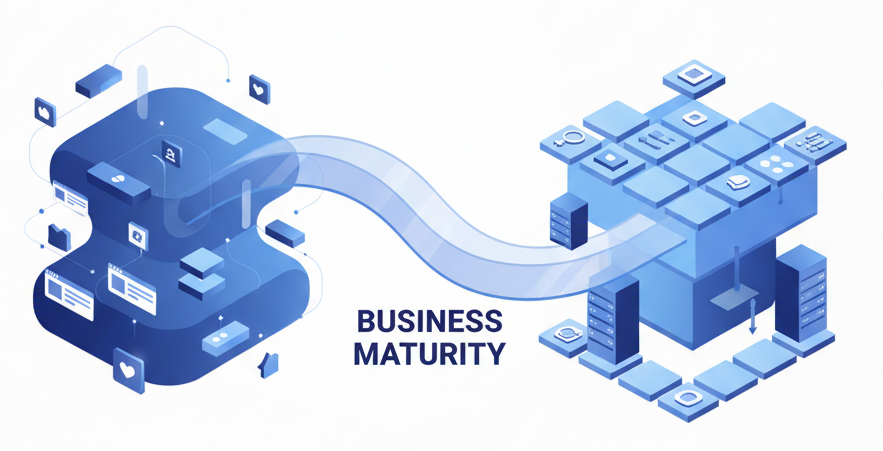
Different platforms solve different problems. Strategic evaluation considers content-driven versus application-driven sites, marketing agility versus engineering control, and customization limits and extensibility. Platforms should match business maturity not trends. Early-stage businesses need speed and flexibility, while mature companies need control and scalability.
Architecture defines how systems communicate. Strategic tradeoffs include speed of development versus flexibility, editorial workflows versus engineering overhead, and frontend performance and customization. Headless is powerful—but not always necessary. Traditional CMS platforms work well for many businesses without the complexity of decoupled systems.
Scalability isn't just traffic—it's system complexity. Strategic planning evaluates content and data volume growth, feature expansion needs, and integration and API readiness. Growth reveals architectural weaknesses early. Systems that work at 1,000 visitors often break at 100,000 without proper planning.
Platform changes are disruptive when poorly planned. Strategic migrations consider data integrity and SEO continuity, downtime and risk management, and future-proofing the new system. Replatforming should reduce friction—not reset it. Poor migrations lose traffic, rankings, and customer trust that take months to rebuild.
Understanding what can go wrong helps design more resilient systems
The platform restricts customization, integrations, or data access, making future changes costly or impractical.
Prevention:
Complex architectures increase cost and slow development without delivering proportional business value.
Prevention:
The platform requires ongoing technical upkeep that the team cannot realistically support.
Prevention:
The platform struggles under increased traffic, content, or feature demand.
Prevention:
Replatforming causes traffic drops, broken URLs, or lost analytics and content.
Prevention:
The platform cannot reliably connect with CRMs, analytics, automation tools, or third-party systems.
Prevention:
Expert guidance becomes critical when platform choice affects revenue or growth, migrations or replatforming are planned, custom integrations are required, or long-term scalability is a priority. At this level, platform mistakes are expensive to reverse.
This pillar acts as the central reference point for how businesses evaluate, select, and implement website platforms that support long-term growth. Below are curated deep-dive guides that explore specific platform decisions, architectural patterns, and migration strategies discussed in this pillar. New guides will be added here as this knowledge base expands.
Strategic frameworks for choosing the right platform for your business needs
These guides focus on how different platforms align with business models, growth stages, and technical requirements.
Guide
Platform comparison focused on control, maintenance, and scalability differences.
Guide
When decoupled architecture makes sense and when traditional platforms work better.
Guide
Evaluating custom development versus platform-based solutions for complex sites.
Planning and executing platform transitions without losing traffic or data
These guides analyze migration planning, risk mitigation, and technical execution for successful replatforming projects.
Guide
Complete framework for planning migrations that preserve SEO and user experience.
Guide
How to maintain rankings and traffic through replatforming transitions.
Guide
Lessons from failed migrations and patterns that lead to successful transitions.
Understanding total cost of ownership beyond platform fees
These guides explore long-term costs, maintenance burden, and ownership implications across different platform choices.
Guide
Comparing total costs including hosting, development, and maintenance over time.
Guide
Understanding ongoing technical requirements for different platform architectures.
Guide
Strategic decision framework for balancing control, cost, and capability.
We help businesses evaluate, design, and migrate website platforms and architectures that support long-term growth without unnecessary complexity, ensuring your foundation scales with your business.
Adding {{itemName}} to cart
Added {{itemName}} to cart